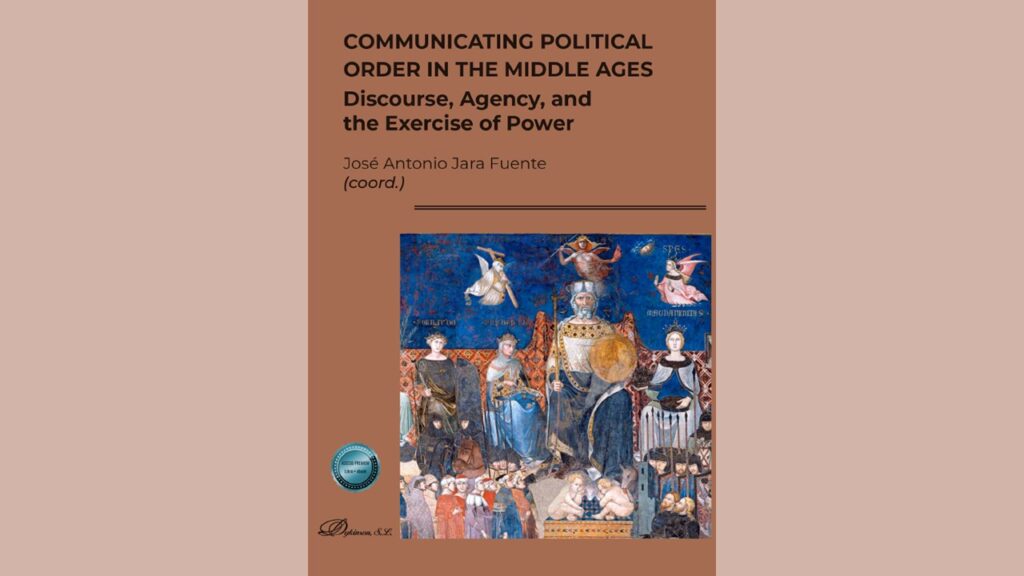
José Antonio JARA FUENTE (coord.)
Communicating political order in the Middle Ages. Discourse, Agency and the Exercise of Power
Madrid, Dykinson, 2026.
ISBN: 979-13-7047-072-2
ISBN electrónico: 979-13-7047-127-9
Political order represents much more than the basic structure of domination operating within a given political entity. It is built upon the interaction of the various political bodies that comprise it, in accordance with what political-constitutional practice establishes in each case, and it is grounded in the communication that necessarily accompanies it. As demonstrated by the studies included in this volume, communication encompasses an extensive array of functions, procedures, agents, channels and instruments, as well as purposes or aims. Communicating the political order, therefore, entails much more than merely declaring and imposing a particular model of order.
The contributions included in this volume are the result of the research project Más allá de la palabra. Comunicación y discurso políticos en la Castilla Trastámara (1367-1504) / Beyond the Word. Political Communication and Discourse in Trastámara Castile (1367-1504). PID2021-125571NB-I00, funded by MICIU/AEI /10.13039/501100011033 and FEDER, UE.
Índice
INTRODUCTION. COMMUNICATING POLITICAL ORDER IN THE MIDDLE AGES
José Antonio Jara Fuente
PART I. COMMUNICATION AND THE PROCESSES OF POLITICAL ORGANIZATION.
Performing Unity and Concord. Political Communication in the City of Cuenca in the 15th Century
José Antonio Jara Fuente
Rebellious Sign Systems in the Medieval Textile Town of Ypres
Jan Dumolyn
Collective Action, Rural Policies and Political Communication in the Villages and the Tierra (Salamanca, Ciudad Rodrigo, Ávila and other nearby Councils, 13th-15th Centuries)
José María Monsalvo Antón
Preserving, Selecting and Organising the Political Communication Testimonies of Castelo de Vide, a small Portuguese town (fifteenth and sixteenth centuries)
Adelaide Millán da Costa
“Por lo que toca al rey y a mi pueblo tengo que morir” [For the sake of the king and my people, I must die]: A Reading from the Citizen’s Perspective of the Principles of Legitimation of the Urban Political System
Hipólito Rafael Oliva Herrer
Royal Words, Majestic Gestures: The Evreux’s Dealings with their Urban Subjects in the Fourteenth and Fifteenth Centuries
Eloísa Ramírez Vaquero
Reform, Feuds, Insults and Debates: Communicating Political Order in the Holy Roman Empire (15th Century – 1525)
Gisela Naegle
PART II. SPECIALIZED AGENTS OF POLITICAL COMMUNICATION.
Political Communication in Urban Government. Public Announcements and the Rhetoric of Power in Late Medieval Castile
Óscar López Gómez
The Intermediate Actors of Political Communication: Messengers from the Cities of the Kingdom of Seville during the Reign of the Catholic Monarchs
Enrique José Ruiz Pilares
Mediators between Powers: Agents of Communication in Seigneurial Towns (Castile, c.1375-c.1460)
Víctor Muñoz Gómez
From the Town to the World. The Political Communication Network of Loulé at the end of the Middle Ages: Agents, Missions and Journeys
Gonçalo Melo da Silva